
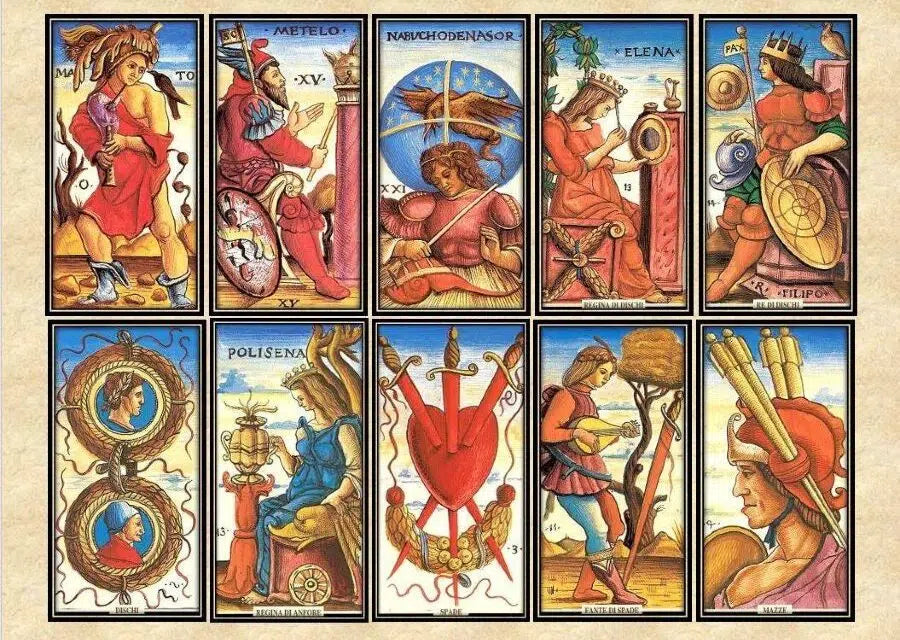
Sola Busca Tarot, the Brera Treasure
Share
It was 2009 when the then Ministry of Cultural Heritage and Activities took advantage of the right of pre-emption reserved to the State and purchased the oldest complete Italian Tarot deck, which is also the oldest in the entire world.
We're talking about the legendary Sola Busca deck. The deck's name obviously derives from the names of its previous owners, the heirs of the Sola Busca family.
The Brera Art Gallery was already the fortunate owner of a marvelous late Gothic deck made for the Duke of Milan, consisting of 48 cards. The so-called "Brambilla deck."
With the acquisition of the Sola Busca deck, Brera has undoubtedly become a true point of reference for all those fascinated by the history of the Tarot.
An important acquisition
The purchase of this deck by the Pinacoteca di Brera is a way to open an important reflection, discussion, and in-depth study on the cultural context, possible sources, and complex iconography of the Tarot.
As you may know, the game of Tarot, which was known as “Triumphi” until at least 1505, was very popular among the upper classes of society as early as the 1450s.
In the Ferrara area, in fact, many documents have been found regarding the supply of illuminated or printed decks for the ducal family. Unfortunately, no trace of these decks has been found so far.
The Lombardy region, on the other hand, seems to have a diametrically opposite history: no documentary evidence has been found, but the actual decks have reached us.
The Sola Busca deck is the oldest complete deck in the world: it features 78 cards, with the 22 trumps, the Major Arcana, and the 56 cards of the four traditional suits: swords, wands, cups, and coins.
The deck is printed on paper from burin engravings, which were mounted on cardboard and then hand-illuminated with colors and gold. A true gem.
It is worth noting how the iconography of the triumphs distances itself from the tradition of fifteenth-century decks: in fact, the Magician opened a sequence that passed through the World and the Last Judgement (Angel), in a sort of elevation from earth to God.
In the Sola Busca deck the triumphs are modelled on warriors of Roman antiquity, heroes of biblical history and in any case illustrious men who served as examples to imitate.
An example of illustrious men is the suit of Swords, which is inspired by the figure of Alexander the Great. This figure was associated with his ascension to heaven in a chariot drawn by griffins, and many Italian lords interpreted it as a desire for immortality.
The suit of Coins is undoubtedly the most interesting from an iconographic point of view, given that it represents for the first time the phases of minting with all the phases of metalworking.
Undoubtedly, this choice was made in light of the medieval alchemical tradition, which saw the transformation of metals as a wonderful metaphor for the human initiatory journey.
For example, the 4 of Pentacles represents Earth, mother of metals, the 5 of Pentacles represents the male element, that is, the alchemist who impregnates the earth with the use of fire, while the 9 of Pentacles represents the famous “nigredo”, a state of matter that is the first step towards its transformation.
Comparing this Tarot deck with alchemical codes is a real joy for experts in the field. Consider, for example, the Ten of Cups, which features a portrait of the famous Hermes Trismegistus, the "Thrice Wise," demonstrating how widespread Hermetic knowledge was in the 15th century.
The probable author of the Sola Busca Deck
By comparing the cards with another deck made without miniatures and with various engravings, it was possible to identify the hand that probably worked on the deck.
It would be a painter from Ancona named Nicola di maestro Antonio, while the possible creator of the iconography of the deck would seem to be a very important humanist: Ludovico Lazzarelli, a native of San Severino Marche.
We are talking about a philosopher, poet, great expert in Greek and Hebrew, scholar of alchemy and Kabbalah who lived for a long time in Rome and Naples.
Lazzarelli is considered one of the greatest exponents among scholars of the humanities of Christian Hermeticism, in constant search of higher knowledge through the study of Christian, Hermetic, and classical sources.
According to reports, the Sola Busca deck, probably recently printed, was illuminated in 1491 in Venice, most likely by Marin Sanudo the Younger, a famous historian and author of the Diaries, who seems to have been passionate about alchemy.
It is therefore remarkable how much this Tarot deck received before being delivered to its first owners. We could say, without fear of contradiction, that the deck purchased by the Pinacoteca di Brera is truly an incredible product, bringing together the finest intellect and knowledge of Italian Humanism.
The scholars who contributed to the creation of this deck belonged to a class of intellectuals who had not yet "fenced off their knowledge."
As we have seen, in the Sola Busca deck, knowledge of classical literature blends perfectly with alchemical knowledge, just as religious principles marry with philosophy and magic.
There are no barriers of any kind, but a single purpose, a grand objective that points directly to Heaven. We are therefore faced with a tool of knowledge that is also a historical testimony of inestimable value.
The deck in question, preserved at the Pinacoteca di Brera, must have been kept as a treasure and not actually used for the game, given its absolutely impeccable condition.
The game played with cards, however, was a path, a journey of inner perfection that began by following the example of illustrious men, then moving on to alchemical practice and hermetic doctrines until reaching divine men.
It was not just a simple tavern game (which was strictly prohibited), but an entertainment that had to be accompanied by a profound knowledge of Christian hermeticism and the desire to elevate oneself to a higher level of consciousness.