
Tarot: How to Read the Minor Arcana
Share
The Tarot deck is made up of 78 cards, 22 of which are called the "Major Arcana." These 22 cards contain the majority of the court cards found in the deck and are the ones that most distinguish the Tarot deck from other playing cards.
The remaining 56 cards, more than two and a half times those of the Major Arcana, make up what are called the Minor Arcana.
If you look at these 56 cards superficially and consider them outside of the complete Tarot deck, they might seem completely identical to regular playing cards. But that's not the case.
The value of the Minor Arcana
It is important to point out that the Minor Arcana of the Tarot are full of symbolic meanings and one should not be fooled by the word “minor”, as they can in fact have a significant impact on the spread.
Their symbolic contribution, although less complex and rich than that of the Major Arcana, is nonetheless considerable and deserves in-depth study, especially by those who intend to use the deck for divination.
It may seem unnecessary to underline the importance of the Minor Arcana to the experts of cartomancy , but beginners, taking the word “minor” too literally and given the similarity to playing cards, often tend to underestimate these very important cards.
From a technical point of view, according to the laws of cartomancy, the Minor Arcana have the task of completing and clarifying the response obtained in the spread.
In short, we can say that they represent the unfolding of human life and each number adds small but important meanings to the figure they symbolize.
As mentioned, novice cartomancy readers tend to overlook these cards, making a classic beginner's mistake. This explains why most novice readings are inaccurate.
For the expert eye of a professional fortune teller, the Minor Arcana represent a veritable goldmine of information and meanings that allow for much more refined and clear readings.
The 56 cards are divided into four suits: coins, clubs, cups, and swords. Each suit has 14 cards, starting with the ace, which is worth 1, and ending with 10. These are called "number cards" because they have numbers instead of face cards.
To these, for each suit, are added four more cards called "face cards": the Jack, the Knight, the Queen, and the King. 10 number cards + 4 face cards = 14 cards, and consequently 14 x 4 = 56.
The numbered cards generally represent situations, while the four face cards represent people. According to some theories, they represent young people who don't yet have defined personalities—androgynous, we might say.
Now that we have a clearer idea of the structure of the Major Arcana, their importance, their role, and their basic principles, let's see how to use them.
How to Read and Interpret the Minor Arcana
Let's start by saying that you can go and read the Minor Arcana considering their close relationship with the Major Arcana, in particular with the first ten.
So let's talk about the Magician, the Popess, the Empress, the Emperor, the Pope, the Lovers, the Chariot, Justice, the Hermit, and the Wheel of Fortune.
For example, we might connect an Ace, which has a value of one, with the Major Arcana of the Magician. This type of reading is based on an interpretation based on the principle that each card in the deck, whether part of the Major or Minor Arcana, represents a step in the human journey of self-development and self-awareness.
It is also possible to associate the figures based on a certain physical-symbolic similarity: for example, the queen can easily be linked to the figure of the Empress.
It follows that each of the four kings present in the Minor Arcana can be associated with the Emperor. The Knight, always following the similarities, can be associated, in terms of power and movement, with the Chariot card.
As for the suits that separate the Minor Arcana, they always prove particularly interesting from an interpretative point of view since they lead directly back to the subdivision of ancient societies.
The suit of Wands represents simplicity and is therefore associated with the middle class, suited to both gambling and offense. The suit of Swords, on the other hand, symbolizes a higher rank, the noble class, which has a strong spiritual connotation and proves to be a formidable tool for offense.
The suit of Cups represents the religious caste, and in fact the cup is a symbol clearly attributable to the ecclesiastical liturgy, but it also refers to meanings linked to the amorous, worldly sphere, closely tied to banquets and the pleasures of the table.
The suit of Pentacles is connected to the social class of artisans and these cards are therefore to be considered symbols of wealth and prosperity.
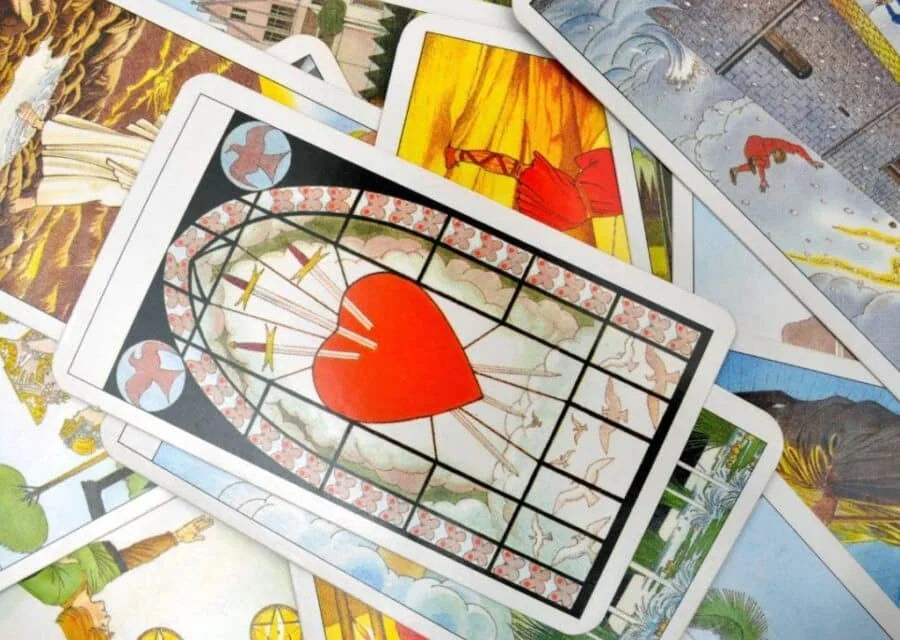
It should be noted that there are particularly rich and beautifully illustrated decks that attempt to graphically embellish even the cards that make up the Minor Arcana.
The cards in question are usually drawn in a stylized manner and each of them is associated with a powerful painted image, the depiction of a scene.
This choice, however, is not merely a stylistic quirk. The presence of symbols, figures, and scenes, even in the Minor Arcana, facilitates interpretation and immediately recalls the appropriate archetypes in the reader's subconscious.
Obviously, you still need to know the deck inside out, in every nuance, but the symbolic representation even in the Minor Arcana makes the connection between card and Arcanum quicker in the fortune teller's mind.
An expert card reader is able to establish a profound relationship with the Tarot deck, with each individual card. The 78 cards penetrate their mind, their subconscious, and even their spirit in some way.
Through practice and study of all the meanings of the cards, the fortune teller becomes highly skilled at connecting with each Arcanum and for him the association between symbol and meaning is immediate.
Richly illustrated decks of cards are a true blessing for experienced fortune tellers, as with a single glance they come into contact with an entire universe of symbols that opens their minds and allows them to make more precise and profound readings.