
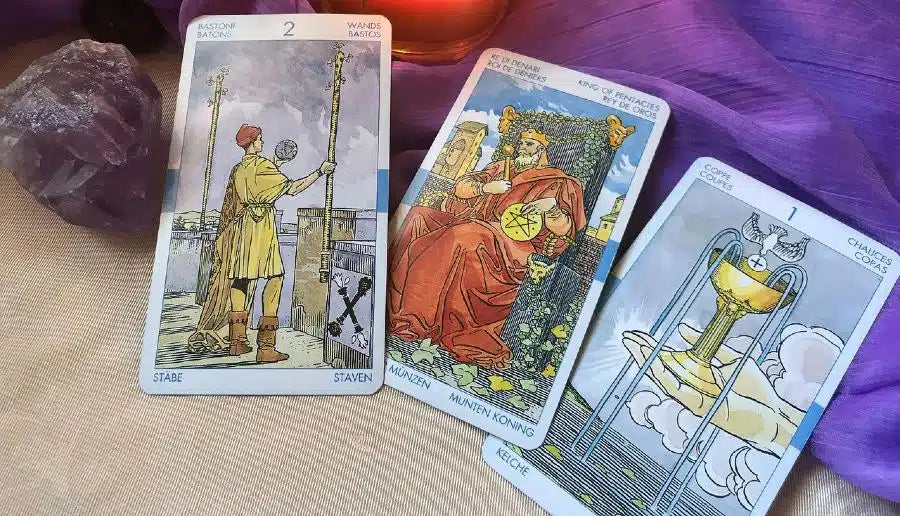
The Intuitive Tarot: A Tool for Self-Knowledge
Share
The wonderful art of using the Tarot through the intuitive method allows us to use this oracular tool, as a symbolic medium, for self-knowledge.
The Tarot deck thus becomes a tool for self-knowledge that allows us to rediscover all the parts that make up our multifaceted personality through the archetypes of the Deck.
To be able to work with the “Intuitive Tarot”, however, a great deal of work must be done to free its symbols from pre-established and pre-assigned meanings.
Very often there is confusion between symbol and archetype, a topic on which many pages could be written. Let's say that the archetype is not just a sign that refers to a meaning, but something that acts in reality.
The Tarot are therefore not symbols that contain a message, or at least they are not only that, because they act directly on reality.
To better understand the power and profound meaning of the Intuitive Tarot, and the process it activates, we will share below a short story of Eastern origin that will better illustrate, through its example, what can be difficult to explain through theory.
One day, from the walls of a city, towards sunset, two people were seen on the horizon embracing. They are a father and a mother, thought an innocent little girl. They are two lovers, thought a man with a troubled heart. They are two friends meeting after many years, thought a lonely man. They are two merchants who have closed a good deal, thought a man greedy for money. It is a father embracing a son returning from war, thought a woman with a tender soul. It is a daughter embracing her father returning from a journey, thought a man grieving the death of his daughter. They are two lovers, thought a girl who dreamed of love. They are two men fighting to the death, thought a murderer. Who knows why they embrace, thought a man with a dry heart. How beautiful to see two people embrace, thought a man of God.
The Magic of Intuition
The story of Eastern origin clearly and unequivocally highlights how a symbolic image, such as the embrace between two human beings, can reach the observer's heart.
The same symbol has different meanings depending on the viewer, their soul, their feelings, and their thoughts. It's like a mirror, the symbolic image, reflecting the meaning each of us carries within us.
Each individual who finds himself faced with the archetype in question draws different reflections from it based also on his predisposition to identify with that symbol, with that image.
But the power of the symbol is greater than this single image because it somehow contains them all, without leaving any out. We can therefore say that the symbol also reminds us that your image, the reflection with which you identify, is one of many. It cannot therefore turn into an obsession.
The archetype is multidimensional: we perceive it in this dimension, but it belongs to others. It follows that it can be interpreted in many ways, more or less refined.
The most harmful readings, from a certain point of view, are those that seek to fix its meaning, to kill the creativity necessary for interpretation.
This is somewhat the tendency of certain interpretative schools of thought that assign only one meaning, or little more, to each Tarot card. Those schools of thought that assign a certain range of meanings to each card seem more interesting.
In this sense, the Intuitive Tarot represents a true revolution, a way to return to the ancient, to recognize the original power of symbols and their potential for direct action on us.
The Tarot acts on us, in the etymological sense, influencing our psyche. They enter within us and move something, shifting and leaving traces of their passage.
Precisely for this series of reasons it is necessary to approach the deck using all the magic of Intuition, thus developing an inner gaze that can take into account the multidimensionality of the symbol and its effect on us.
In this way we will move away from the pre-established and fixed meanings of the symbol and will take more into account what that archetype has opened up within us, its effect on our creative imagination.
This is a completely new approach to the Tarot that does not depart entirely from tradition, but which seeks to avoid the rigidity of established schemes with a view to a completely personal symbolic fruition.
“The Intuitive Tarot”, by Prembodhi and Rajendra, published in 1979 by Re Nudo Editore, was undoubtedly the first book to address this approach in a systematic and precise manner.
It should be remembered that at the time of this book's publication, the Italian public knew the Tarot only as the Marseilles deck, while this text primarily examined the Waite deck.
This book therefore has the merit of having introduced the Intuitive Tarot method to our country and of having brought Italians closer to the Waite deck.
Why use the Intuitive Tarot?
The intuitive approach to the Tarot deck is truly powerful and engaging. By not recognizing predefined meanings in the cards, an inner door opens that allows for surprising creative communication between individuals and groups.
We're no longer tied to memorizing the meaning of a particular card, but instead look into our psyche to understand what we can see in that card; what it tells us, what it projects, which parts of ourselves it reflects, and even how to express and live it peacefully.
The cards of the Tarot deck become a series of mirrors that allow us to analyze ourselves and know ourselves better, more deeply, even rediscovering what we don't admit to being.
Looking at ourselves through that multitude of mirrors, we can rediscover ourselves, in all our identities, without masks, without fears, without having to hide anything.
For this reason, the Intuitive Tarot proves to be an extremely interesting and suitable method for freeing our true self, in order to photograph the present and imagine new futures.