
Astrology: Introduction to the Astrological Houses
Share
Anyone interested in horoscopes has heard the term "Astrological Houses" a thousand times. They know that they are extremely important for understanding a person's zodiac sign, but they often lack a precise understanding of what the astrological house system is and how it works.
In this article, we'll try to shed some light on this matter, and we can already tell you that we intend to discuss each "Astrological House" in more detail in future articles.
What are the Astrological Houses?
To define the Astrological House, it's enough to say that it constitutes each of the twelve sectors belonging to the subdivision of the local celestial sphere. This subdivision virtually overlaps with the signs of the zodiac and the fixed stars.
To divide the sky into 12 sectors, or Domification, there are different methods, but the most widely used is undoubtedly the one proposed by the Perugian monk Placido di Titi in the seventeenth century.
The Placidian method proved to be much more rigorous and precise than previous methods because it took into account the irregularities of the ecliptic. To achieve this, the Placidian method divided the celestial sphere into diurnal and nocturnal semi-arcs.
How the House Cycle Works
Let's try to explain the House system as best we can, even though it may not be very easy to understand at first: to do so, simply try to visualize the path of the Sun and the Moon.
Thanks to the Placidian method, this path is divided into four semi-arcs: two diurnal and two nocturnal. The first begins with sunrise and ends when the sun reaches its maximum altitude, the second begins at its maximum altitude and ends at sunset. The same applies to the two semi-arcs governed by the moon.
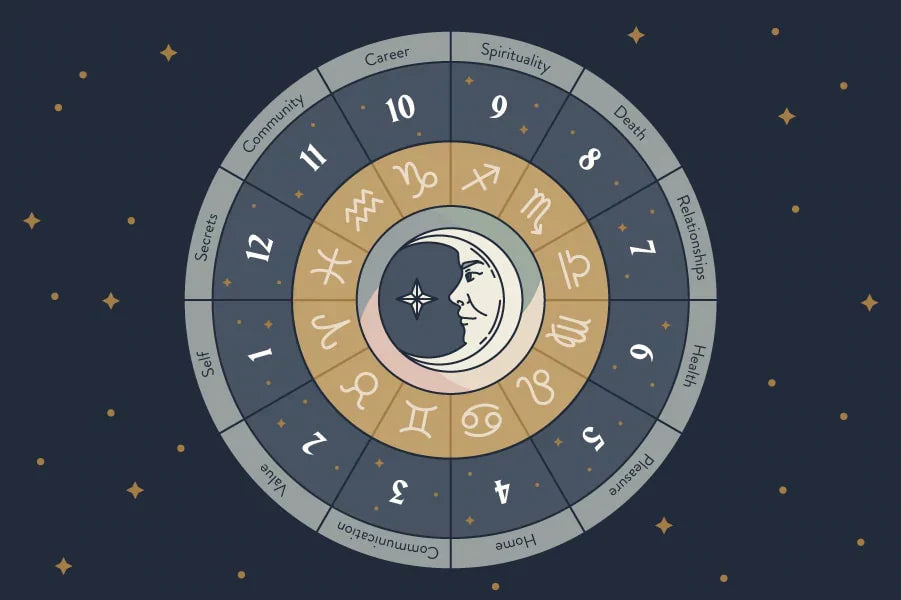
When looking at a Natal Chart, you'll notice that the 12 Houses are marked by Roman numerals, starting with I, the Ascendant, which begins the first House, and ending with the 12th. The path runs from East to West, from the Ascendant to the Descendant.
In fact, the Ascendant, in the celestial sphere, is the point created at the intersection between the Ecliptic and the Eastern Horizon: even more specifically, it can be said that the Ascendant is the point of the Ecliptic that at a given time of day or night rises in the East in a specific place.
When, due to the apparent movement of the celestial vault, this point reaches the Meridian, that is, the point where the Sun during the day and the Moon at night reach their maximum height above the horizon, the diurnal semi-arc can be said to be complete.
Before reaching the Meridian however, at a third of the diurnal semi-arc you will encounter the Cusp of the XII House, while at two thirds of the semi-arc the Cusp you will encounter is that of the XI House.
Therefore, in order to better understand the matter, it should be noted that the path of the Houses, after the Ascendant, proceeds with a succession that we could define as contrary: XII, XI, X, IX…
Once you reach the Meridian point, you will find the Cusp of the Tenth House, also known as the "Middle Coeli," the Midheaven. Following its path, you will descend toward the western horizon, or the sunset.
The path of the second semi-arc of the day unfolds from Midheaven to Sunset, and one-third of the way through you will encounter the Cusp of the IX House, while two-thirds of the way through you will reach the beginning of the VIII House.
Once the Descending point is reached, that is, the point where the Ecliptic meets the western horizon, the Cusp of the VII House will be found there and thus the second semi-diurnal arc closes.
At the same time, the two nocturnal semi-arcs open: the same procedure applies with the same reference points. In this case, therefore, the cusps of the 6th, 5th, and 4th Houses will meet during the first nocturnal semi-arc until they reach the nocturnal equivalent of the Meridian and its opposite, that is, the "Depth of the Heavens."
From here, obviously, begins the second nocturnal semi-arc, the fourth and last of the entire cycle, which will meet the Cusps of the III and II Houses before returning to the Ascendant and the eastern horizon.
Corner, Succedent and Cadant Houses
The Astrological Houses are divided into various subgroups based on certain characteristics that we will present to you below as clearly as possible.
The division is made up of three groups, each of which obviously contains four houses. The dividing line is the point covered in the motion.
The Astrological Houses, so-called “Angular”, are the 4 houses that precede each “Corner of the World” and lead the stars to one of the four main moments of diurnal motion.
The First House leads to the rising of the Sun, the Tenth House leads to the Midheaven, the Seventh House brings the path of the Sun towards the setting, while the Fourth House moves the path to the night part, to the Bottom of the Sky.
In practice, wanting to see the Ecliptic as a simple circumference intersected by the Earth's plane, the Angular Houses represent the 4 limiting points: Sunrise, Meridian, Sunset, Bottom of the Sky. East, South, West, North. I, X, VII, IV.
Symbolically, these four astrological houses are linked to the relationship with the body and the present. While the 2nd, 11th, 8th, and 5th houses, which precede the angular houses, are called "Succedents."
These astrological houses, from a symbolic point of view, represent the future and are related to both the body and the soul. Then there are the so-called "Cadent" astrological houses, which follow the angular ones: the XII, the IX, the VI, and the III.
The title “cadenti” is very evocative because in the diurnal motion they represent the points at which “one falls from the corner”, as if the corners represented the hinges of the world, from which the stars fall.
This last group represents the past and is directly related to the soul. According to experts, the four Angular Houses have a very strong influence on people, the Succedent Houses have a medium influence, and the Cadent Houses have a rather limited influence.
Now that we have a solid theoretical foundation on the motion of the stars and the succession of the Astrological Houses, we intend to analyze their astrological functions House by House in future articles.